
Fantasy Pantheon Ideas of Gods and Goddesses
In many dark fantasy books, divine favor is rarely a blessing without consequence. In the Bowa Realm, humanity’s evolution hinges on a single, dangerous pillar: the lineage families. Twenty demigods embody the fundamental forces of existence, and their power must be anchored to the mortal world through human heirs. Twelve of these gods exist in paired dualities, while the remaining eight stand alone.
Each pairing demands at least one living human representative, requiring a minimum of six active heirs, while every solo god must always have a single heir in place. In rare cases, even dual lineages demand two simultaneous representatives, turning divine selection into a fragile balance where favor can quickly become a curse.
If a lineage family ever falls, another must eventually take its place. That transition, however, is never immediate. It can take months or even years before a new family is chosen and fully empowered. During that gap, the world is left unbalanced, and the consequences of that missing divine influence begin to surface.
In dark fantasy books, this absence is rarely subtle. If the lineage of life and death were to fall, miscarriages and stillbirths would rise, healing would fail more often, and hospitals would remain overcrowded as the natural cycle of existence begins to fracture.
Fantasy Pantheon Ideas of Gods and Goddesses
Who are these Deities?
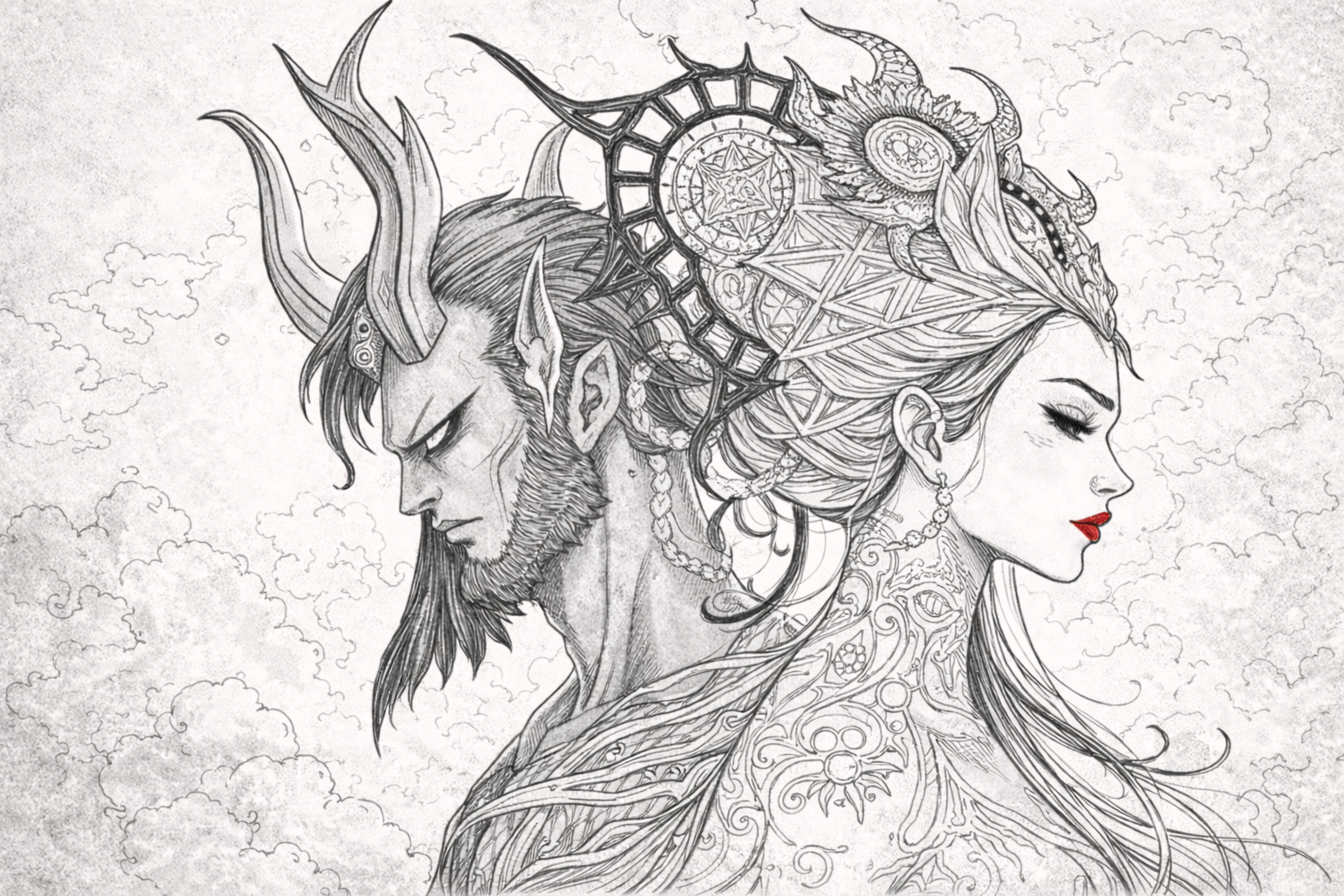
The twenty gods stand today as a representation of the Bowa Realms creation and how it holds up. Let’s do a quick look at each god’s name and role:
Fantasy Pantheon Ideas of Gods and Goddesse
Life & Death
Life: The existence of all organic life
Name: Deity Liyla
Death: The opposite end of life to keep life moving; inevitable
Name: Deity Deliano
Space & Time
Space: The existence of the realms’ atmosphere
Name: Deity Sperano
Time: Passage – A concept of death
Name: Deity Tinamo
Tangible & Abstract
Tangible: All feasible mass
Name: Deity Talleo
Abstract: The thought behind creation
Name: Deity Abra
Order & Chaos
Order: Logic and Phsyics
Name: Deity Orphelia
Chaos: Free will, Triggers Mind’s desire for exploration
Name: Deity Chentellio
Creation & Ruin
Creation: Physical manipulation of non-organic material
Name: Deity Crescenzo
Ruin: Erasure to open space up for the new
Name: Deity Rumelio
Joy & Woe (Interchangeably Day & Night)
Joy/ Day: The positive side of humanity
Name: Deity Jonna
Woe/ Night: The release of negative energy
Name: Deity Wonsumo
Memory
Retention of information
Name: Mezzono
Dream
Imagination without limitation
Name: Deity Dretmo
Fate
Natural events and phenomena
Name: Deity Fannala
Flow
How things move and interact
Name: Deity Flanesso
Flow
Human connection
Name: Deity Boma
Elements
Air and water currents, plant life, and heat
Name: Deity Elange
Culture
Expression of identity
Name: Deity Cufanzo
Exchange
Help to survive and strive
Name: Deity Excellioh
Fantasy Pantheon Ideas of Gods and Goddesses
How the Pantheon Came to Be
My fantasy pantheon ideas of gods and goddesses began with a single question rather than a full divine hierarchy. The concept started with the Joy Sorcerer, the original foundation for my main character, envisioned as a counterpoint to the Light Sorcerer. As the world expanded, so did the need to understand where such powers originated, how they functioned, and why they existed at all. That curiosity evolved into a structured pantheon, grounded in logic, balance, and an otherworldly framework that ties directly into the rules of the world.
While none of my characters exist as true gods, their abilities are rooted in divine influence, making a higher, mystical presence necessary to explain how divine favor can shape, and ultimately curse, the lives of those chosen to carry it.
fantasy pantheon ideas of gods and goddesses
Read more with other core series posts:
What Makes Dark Romance Fantasy So Addictive?
Meet Solus Cerventes: Dark Fantasy Female Protagonist – & the Cast
The World of Kinawa in Stained Hearts
The Fascinating Mythic Foundations of Stained Hearts
Follow at: x.com/A_L_Vesper